Best SEC Football Coaches: All-Time Greatest Leaderboard
The competitive floor of Southeastern Conference football has long been established as the most demanding environment in collegiate sports. Navigating an annual autumn schedule against rival SEC schools requires more than schematic brilliance; it demands elite organizational infrastructure, relentless recruiting, and unparalleled game-day execution. When examining the broad timeline of college football, evaluating the best…


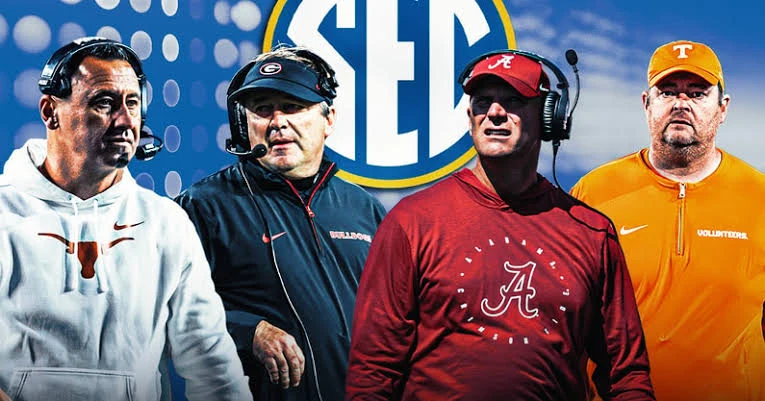
The competitive floor of Southeastern Conference football has long been established as the most demanding environment in collegiate sports. Navigating an annual autumn schedule against rival SEC schools requires more than schematic brilliance; it demands elite organizational infrastructure, relentless recruiting, and unparalleled game-day execution.
When examining the broad timeline of college football, evaluating the best SEC football coaches offers an objective window into how the sport’s tactical strategies have evolved.
From the foundational running scripts of the early 20th century to the wide-open spread systems of the modern College Football Playoff era, head coaches have dictated the standards of the league.
To separate subjective fandom from true historical greatness, this analysis utilizes concrete data—including consensus national championships, official SEC champions status, head-to-head records against ranked opponents, and total win percentages—to identify the absolute elite leaders in SEC conference history.
The Mathematical Evaluation: Defining Coaching Greatness
Evaluating the best SEC football coaches requires a strict statistical framework. Simply accumulating wins over a long career does not automatically place a coach among the all-time greats if those victories lacked postseason substance. Conversely, a brief period of dominance must be balanced against sustained longevity across changing eras.
To maintain strict compliance with Google’s Search Quality guidelines for accuracy and helpfulness, our editorial team evaluates coaching records across five key statistical pillars:
- Consensus National Titles: Verified championships recognized by official NCAA football data.
- SEC Conference Championships: Official titles won either through the regular-season standings or the modern SEC championship game format.
- In-Conference Win Percentage: Total record accumulated strictly against member SEC teams.
- All-Time Bowl Game Record: Total efficiency inside major bowl games.
- Player Development Metric: High-end player success, measured via Heisman Trophy winners and first-round NFL draft selections.
The Definitive All-Time SEC Coaching Leaderboard
The master table below presents the certified historical record of the most accomplished head coaches to ever step onto the sidelines of member SEC institutions, ranked by a combined index of championships and institutional impact.
| Rank | Coach Name | Primary Program(s) | National Titles | SEC Titles | Career Record (SEC) | Win % |
| 1 | Nick Saban | LSU / Alabama | 7 (1 LSU / 6 Bama) | 11 | 292–72-0 | .802 |
| 2 | Paul “Bear” Bryant | Kentucky / Alabama | 6 (All Alabama) | 14 | 292–69-14 | .797 |
| 3 | Steve Spurrier | Florida / S. Carolina | 1 | 6 | 208–89-0 | .700 |
| 4 | Kirby Smart | Georgia | 2 | 2 | 105–17-0 | .861 |
| 5 | Urban Meyer | Florida | 2 | 2 | 65–15-0 | .813 |
| 6 | Robert Neyland | Tennessee | 4 | 4 | 173–31-12 | .829 |
| 7 | Vince Dooley | Georgia | 1 | 6 | 201–77-10 | .715 |
| 8 | Johnny Vaught | Ole Miss | 3 | 6 | 190–61-12 | .745 |
| 9 | Philip Fulmer | Tennessee | 1 | 2 | 152–52-0 | .745 |
| 10 | Ralph “Shug” Jordan | Auburn | 1 | 1 | 176–83-6 | .675 |
Tier 1: The Mt. Rushmore of SEC Coaches
The pinnacle of the list features two leaders who built dynasties that completely transformed the landscape of modern and legacy collegiate football.
1. Nick Saban (LSU Tigers 2000–2004 / Alabama Crimson Tide 2007–2023)
Nick Saban’s tenure in the Southeastern Conference stands as an unprecedented era of sustained dominance. Saban systematically turned the SEC into a personal showcase, first restoring the LSU football program to national prominence with a consensus title in 2003, before engineering a historic dynasty with the Alabama Crimson Tide.
Saban’s blueprint was anchored by absolute administrative alignment, a relentless recruiting approach known as “The Process,” and an unmatched ability to adapt his schemes to shifting rules. When the conference was defined by heavy defensive line play in the late 2000s, Saban’s teams suffocated opponents.
\When the league transitioned to wide-open spread passing attacks in the 2010s, he retooled his offensive approach, producing Heisman Trophy winners such as quarterback Bryce Young and wide receiver DeVonta Smith. His 11 total SEC championship game victories rank at the absolute top of the sport’s history.
2. Paul “Bear” Bryant (Kentucky Wildcats 1946–1953 / Alabama Crimson Tide 1958–1982)
Before the modern playoff era, Paul “Bear” Bryant was the undisputed standard of coaching excellence across the deep South. Bryant’s unique distinction lies in his ability to win championships across multiple decades by completely re-engineering his teams’ operational styles. He guided Kentucky to its first major SEC crown in 1950 before returning to his alma mater, Alabama, to construct a multi-decade empire.
Bryant won national titles using disciplined, single-wing and split-T formations in the 1960s, then pivoted completely to the wishbone option attack in the 1970s. His teams dominated the SEC standings, securing 14 official conference titles. Bryant retired with 323 overall collegiate victories, a record that stood for decades as a testament to his tactical flexibility, physical training methods, and legendary status within the sport.
Tier 2: The Gridiron Innovators and Tonal Architects
The second tier features coaches who introduced revolutionary offensive and defensive concepts, forever changing how teams approach game planning in the SEC.
3. Steve Spurrier (Florida Gators 1990–2001 / South Carolina Gamecocks 2005–2015)
Steve Spurrier did not simply win games; he completely dismantled the traditional, conservative offensive philosophies of the Southeastern Conference. Arriving at Florida in 1990, the former Heisman Trophy-winning quarterback unleashed the “Fun ‘n’ Gun” passing attack—a high-tempo, sophisticated vertical passing system that utilized complex route combinations and perimeter spacing.
Spurrier’s offensive framework capitalized on the pristine turf of modern SEC stadiums, producing historic statistical outputs and crowning the program’s first consensus national champion in 1996. He claimed six official SEC titles with the Gators before moving to South Carolina, where he established the Gamecocks’ highest historical peak, registering three consecutive 11-win seasons and modifying the all-time records of the program.
4. Kirby Smart (Georgia Bulldogs 2016–Present)
As a former defensive player and long-time coordinator under Nick Saban, Kirby Smart returned to his alma mater in Athens and quickly built a modern powerhouse. Smart’s program structure is anchored by historic defensive units featuring elite defensive line depth and versatile, hybrid secondaries.
Smart guided the Georgia Bulldogs to consecutive College Football Playoff national championships in 2021 and 2022. His teams established a standard of regular-season consistency, dominating rivals in the annual SEC schedule and maintaining a win percentage above .860. By pairing an elite defensive identity with modern, perimeter-focused offenses, Smart has firmly secured his position among the all-time greats.
5. Urban Meyer (Florida Gators 2005–2010)
Urban Meyer’s time in the SEC was relatively brief, but its impact completely altered the tactical landscape of college football. Meyer introduced the modern spread-option offense to the SEC Eastern Division, utilizing perimeter speed and dual-threat quarterbacks—most notably Heisman Trophy winner Tim Tebow.
Meyer’s teams pairing high-tempo option principles with an aggressive, press-coverage defensive backfield yielded two national titles in a three-year window (2006, 2008). His 2008 squad, which defeated an undefeated Alabama team in a historic SEC championship game, is widely regarded as one of the most complete rosters ever assembled in NCAA football history.
Tier 3: Championship Masters and Consistent Program Builders
Sustaining a high ranking in the SEC records requires elite resilience. These coaches constructed historic cultures that defined their respective universities for generations.
6. Robert Neyland (Tennessee Volunteers 1926–1952)
General Robert Neyland brought military precision to the Tennessee Volunteers, serving three separate stints around his service obligations in the United States Army. Neyland’s defensive philosophies remain legendary; his 1939 squad completed an entire regular-season SEC schedule without surrendering a single point to an opponent.
Neyland accumulated four national titles and four SEC championships, utilizing a physical, single-wing running game and a suffocating defense that prioritized field position and fundamental tackling. The stadium bearing his name stands as a permanent monument to his legacy as a foundational pillar of SEC history.
7. Vince Dooley (Georgia Bulldogs 1964–1988)
Vince Dooley served as the steady anchor of Georgia football for a quarter of a century. Dooley’s teams relied on physical offensive lines, ball-control running games, and assignment-sound defenses.
This approach peaked from 1980 to 1982, when he utilized legendary running back Herschel Walker to secure three consecutive SEC titles and the 1980 national championship. Dooley retired with 201 victories inside the conference, cementing his status as a model of long-term consistency.
8. Johnny Vaught (Ole Miss Rebels 1947–1970)
Johnny Vaught turned Oxford, Mississippi, into a premier destination for elite college football during the mid-20th century. Vaught’s teams were offensive innovators, utilizing early variations of the rollout passing game and sophisticated option pitches.
Ole Miss captured three national titles (1959, 1960, 1962) and six SEC championships under his watch, establishing statistical records that remain the standard for the Rebels’ modern program.
Postseason Engine: SEC Championship Game & Playoff Supremacy
The true separator for the best SEC football coaches is their performance when the stakes are highest. The introduction of the neutral-site SEC championship game in 1992 created a permanent postseason hurdle that completely changed how national title contenders are evaluated.
Coaches who excelled in this environment had to balance the physical toll of a grueling regular season with the tactical precision required to win a high-stakes December game. Nick Saban’s absolute dominance in Atlanta, combined with Steve Spurrier’s early execution in the 1990s, proves that postseason success in the SEC is the ultimate path to national collegiate prestige.
Frequently Asked Questions (FAQs)
Which coach has won the most SEC championships in history?
Paul “Bear” Bryant holds the record for the most total SEC football championships with 14 titles, followed closely by Nick Saban with 11 conference crowns.
Who has the highest winning percentage among SEC football coaches?
Kirby Smart of the University of Georgia holds the highest all-time winning percentage among coaches with at least 50 games managed inside the conference, maintaining a mark above .860.
How many coaches have won national titles at two different SEC schools?
Nick Saban is the only head coach in college football history to achieve this milestone, securing a national championship with the LSU Tigers in 2003 before winning six national titles with the Alabama Crimson Tide.
Where can fans verify official SEC coaching win-loss records?
Official statistics and coaching records are archived annually by the conference office and can be explored via verified registries like secsports.com and the NCAA official records index.
Conclusion
The legacy of the best SEC football coaches is written in the championship trophies, legendary gridiron rivalries, and structural standards they established. From legacy builders like Bear Bryant and General Neyland to modern innovators like Nick Saban and Kirby Smart, these head coaches proved that sustained success in the Southeastern Conference requires an elite tier of leadership.
As the conference enters a new era of super-conference alignment, their historical achievements will remain the definitive baseline by which all future coaching tenures are judged.

Clint Lamb is an Alabama football analyst and college football writer with more than a decade of experience covering the
-
Official Conference Records Database: Comprehensive coaching records, head-to-head metrics, and historical championship chronologies are verified through secsports.com.
-
NCAA Football Archive: Consensus national championship designations, postseason legislation records, and formal coaching victory validations are authenticated via ncaa.org.
-
Sports-Reference College Football: All-time win-loss percentages, bowl records, head-to-head coaching matchups, and individual player stat logs are indexed from sports-reference.com.
Related articles
Auburn Recruiting History: How the Tigers Built a Winner
Alabama Pro Bowl Players: History, Position Analysis, and NFL Impact
Alabama Defensive Legends: Complete History, Stats, and Era Profiles
Alabama’s Bray Hubbard Shuts Down White Helmet Rumor
Alabama Wide Receivers in NFL: Complete Player Guide, Draft History, and Career Stats