Jordan-Hare Stadium Guide: History, Traditions, and Everything to Know
Few venues in college football carry the atmosphere of Jordan-Hare Stadium. Home to the Auburn Tigers since 1939, this Jordan-Hare Stadium guide walks through everything that makes it one of the most respected—and feared—environments in the sport, from its capacity and construction history to the traditions that turn a Saturday in Auburn into an all-day…


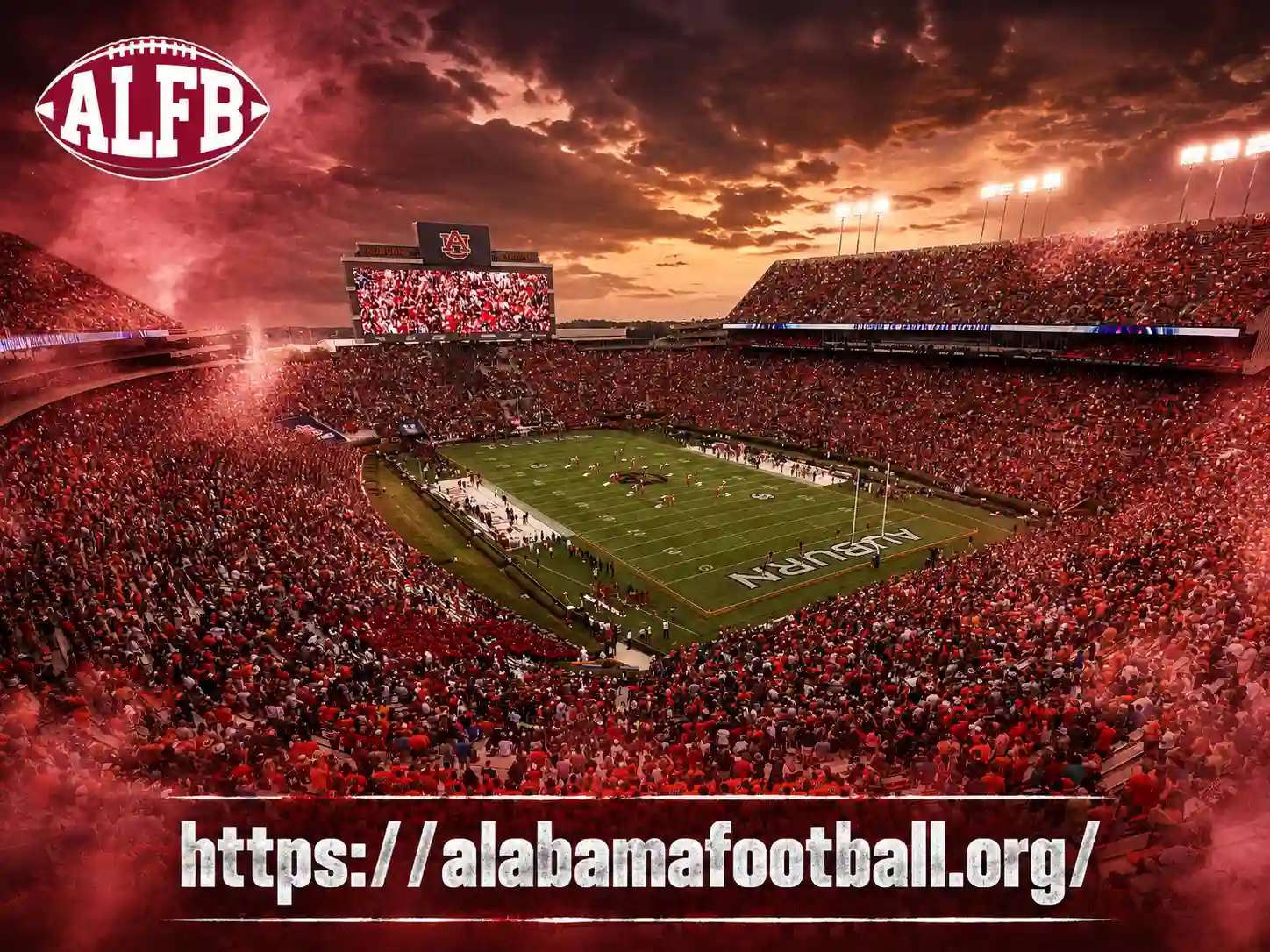
Few venues in college football carry the atmosphere of Jordan-Hare Stadium. Home to the Auburn Tigers since 1939, this Jordan-Hare Stadium guide walks through everything that makes it one of the most respected—and feared—environments in the sport, from its capacity and construction history to the traditions that turn a Saturday in Auburn into an all-day event.
Nestled on Auburn University’s campus in Auburn, Alabama, the stadium has grown from a modest 7,500-seat facility into one of the largest on-campus venues in the country. It has hosted national championship runs, the “Kick Six,” and decades of SEC football that shaped the Alabama-Auburn rivalry.
Whether you’re planning your first trip to The Plains or just want the full picture of the stadium’s history, this guide covers it all.
Quick Facts Table
| Category | Detail |
|---|---|
| Stadium Name | Pat Dye Field at Jordan-Hare Stadium |
| Location | Auburn, Alabama (Auburn University campus) |
| Opened | November 30, 1939 |
| Current Capacity | 88,043 |
| National Ranking (On-Campus Stadiums) | Among the 12 largest in the NCAA |
| Home Team | Auburn Tigers |
| Conference | SEC |
| Playing Surface | Grass |
| Named For | Ralph “Shug” Jordan and Cliff Hare |
| Field Named For | Pat Dye (since 2005) |
| Upcoming Project | $323 million North Endzone Multipurpose Events Center (construction beginning summer 2026) |
Jordan-Hare Stadium History
From Auburn Stadium to a College Football Icon
The venue that would become Jordan-Hare Stadium opened as Auburn Stadium on November 30, 1939, with the Tigers hosting Florida in a game that ended in a 7-7 tie.
At the time, the stadium seated just 7,500 fans in a single lower grandstand — nowhere near enough to host Auburn’s biggest games, which were often played at neutral sites like Legion Field in Birmingham or in Columbus, Georgia, well into the 1970s.
In 1949, the facility was renamed Cliff Hare Stadium in honor of Clifford Leroy Hare, a member of Auburn’s first football team who later became dean of the university’s School of Chemistry and served as president of the old Southern Conference. That same year, a permanent east-side grandstand pushed capacity to 21,500.
The Shug Jordan Era
Ralph “Shug” Jordan took over as Auburn’s head coach in 1951 and spent the next 25 years transforming both the program and its home stadium. Under his watch, the venue became a horseshoe in 1960 and a full bowl by 1970. By the time Jordan retired in 1975, capacity had more than tripled to 61,261.
In 1973, while Jordan was still coaching, the university renamed the venue Jordan-Hare Stadium in his honor—making it the first stadium in the United States named for an active head coach. Jordan finished his Auburn career with a 176-83-6 record and remains the program’s all-time winningest coach.
Expansion Through the Decades
Jordan-Hare’s growth didn’t stop with Jordan’s retirement. Major additions followed in 1980 (west upper deck) and 1987 (east upper deck), pushing capacity to roughly 85,214 and briefly making it the largest stadium in Alabama, ahead of Bryant-Denny Stadium at the time.
| Year | Capacity Milestone |
|---|---|
| 1939 | 7,500 (original construction) |
| 1949 | 21,500 |
| 1960 | 44,500 |
| 1970 | 61,261 |
| 1980 | 72,169 |
| 1987 | 85,214 |
| 2000-2001 | 85,612 – 86,063 |
| 2004 | 87,451 |
| 2023 | 88,043 (current capacity) |
A series of smaller 21st-century expansions—in 2000, 2001, and 2004—added luxury suites and general seating. The most recent bump came in 2023, when additional premium seating brought the stadium to its current capacity of 88,043, making it one of the dozen largest stadiums in the NCAA.
The Pat Dye Name
On November 19, 2005, Auburn honored former head coach and athletic director Pat Dye by naming the playing surface Pat Dye Field, giving the venue its full modern title: Pat Dye Field at Jordan-Hare Stadium. Dye led Auburn from 1981 to 1992, compiling a 99-39-4 record and winning four SEC championships before his induction into the College Football Hall of Fame in December 2005.
When the Iron Bowl Came to Auburn
For decades, the biggest game on Auburn’s schedule — the Iron Bowl against Alabama — was played exclusively at Legion Field in Birmingham, largely because Jordan-Hare couldn’t match Legion Field’s seating capacity. That changed once the 1980s expansions pushed Jordan-Hare past Legion Field’s capacity.
On December 2, 1989, Auburn hosted its first-ever Iron Bowl on campus and upset No. 2 Alabama 30-20, a result Auburn fans still point to as validation of the decades-long push to bring the rivalry home.
Gameday Traditions at Jordan-Hare Stadium
Jordan-Hare isn’t just known for its size—it’s known for what happens inside and around it on a Saturday. These traditions are as central to the Auburn football identity as the team itself.
Tiger Walk
Roughly two hours before kickoff, the Auburn Tigers make their way from the athletics complex to the stadium down Donahue Drive, flanked by thousands of fans cheering them on. Tiger Walk has become one of the most copied pregame traditions in college football and sets the tone for the entire gameday atmosphere.
The Eagle Flight
Before kickoff, one of Auburn’s raptors takes flight from the top of the stadium and circles down to land at midfield while the crowd roars “War Eagle.”
Since 2001, that role has largely belonged to Spirit, a bald eagle discovered as an injured fledgling in Florida in 1995 and brought to Auburn’s Southeastern Raptor Center in 1998. Because of a damaged beak, Spirit cannot be released into the wild, making him a permanent—and beloved—fixture of Auburn game days.
War Eagle
“War Eagle” is more than a chant—it’s Auburn’s all-purpose greeting, battle cry, and fight song title rolled into one. Auburn has kept a live eagle associated with the football program since the 1930s, and the phrase is shouted during the pregame Eagle Flight, at kickoff, and really any time two Auburn fans cross paths.
Rolling Toomer’s Corner
After a win, Auburn fans flood the intersection of College Street and Magnolia Avenue—Toomer’s Corner—to throw rolls of toilet paper into the trees, a tradition dating back to 1972.
According to Auburn University, the tradition’s roots trace to the 1960s, when Toomer’s Drugstore held the only telegraph line in town and threw ticker tape from road-trip win updates over the power lines outside.
The two original oak trees at the corner were removed in 2013 after a rival fan poisoned them. Two replacement live oaks were planted in 2017, and after a period of protecting the young trees, the full “rolling” tradition returned to Toomer’s Corner in 2023.
Additional Gameday Rituals
- War Eagle Road: Special rumble strips on South Donahue Drive play the opening notes of the “War Eagle” fight song when driven over.
- Come Home to the Corner: A Friday-night block party in downtown Auburn featuring live music and extended shopping hours.
- Sweet Home Alabama: Traditionally played after Auburn home wins.
- Locker Room Tours: Open to the public the Friday before home games.
Stadium Features and Fan Experience
Seating and Sightlines
Jordan-Hare’s bowl design wraps the lower grandstand fully around the field, with upper decks on the east and west sides. The home team (Auburn) is positioned in front of the west stand, while the visiting team sits across from the east side, where the stadium’s loudest student sections are traditionally located—directly behind the visitors’ bench.
That layout is part of why Jordan-Hare has built its reputation as a difficult place for opposing offenses to operate. Because the seating bowl fully encloses the field rather than leaving open corners, crowd noise has fewer places to escape, and visiting quarterbacks have described struggling to hear snap counts during Auburn’s loudest night games.
The stadium’s exterior is also home to ten large murals, commissioned in 1998 and updated in later years, depicting some of the greatest players, teams, and moments in Auburn football history along the east-side wall.
The Videoboard
Auburn’s south end zone video display debuted before the 2007 season as a $2.9 million, 30-by-74-foot HD Daktronics screen. It was replaced in 2015 by a significantly larger board, and Auburn added further videoboard investment on the north side in 2024 as part of ongoing stadium upgrades.
Concessions and Amenities
Game day concessions inside Jordan-Hare include multiple Chick-fil-A locations, regional favorites like Momma Goldberg’s Deli and Chicken Salad Chick, and mobile ordering options through Grab-N-Go stands such as Bodda Getta Market and War Eagle Express.
Alcohol is not sold inside the stadium, and outside food and drink are prohibited apart from one factory-sealed water bottle per person.
Beyond concourse-level offerings, Jordan-Hare has hosted a handful of non-football events over the decades, including concerts and public gatherings, underscoring its role as more than a single-sport venue even before the current renovation project broadens that use case further.
Bag Policy and Entry Rules
Fans should plan around Jordan-Hare’s clear-bag policy, which permits bags no larger than 12″ x 6″ x 12″. Prohibited items include artificial noisemakers, oversized camera lenses, video cameras, and weapons of any kind, including pocket knives.
The North Endzone Project: What’s Changing at Jordan-Hare
Auburn’s Board of Trustees gave final approval in April 2026 for the largest capital construction project in the athletic department’s history: a $323 million renovation centered on the stadium’s north end zone.
Project Scope
The plan combines two components:
- A $305 million multipurpose events center — a seven-story, roughly 300,000-square-foot addition featuring more than 3,000 new premium seats, a ballroom, expanded dining (including a new food hall), and flexible event and meeting space.
- An $18 million North Plaza — an elevated pedestrian plaza connecting the new facility to Petrie Hall, spanning over Heisman Drive.
Timeline
Construction is scheduled to begin in summer 2026. According to Auburn Athletics, the first phase is targeted for completion by fall 2028, with the full project finished by spring 2029.
Athletic director John Cohen called it a milestone moment for the university, describing the project as extending well beyond football, given its year-round dining, event, and student-space components.
Why It Matters
The addition builds on Auburn’s earlier north-side investments, including a roughly $26 million videoboard upgrade completed in 2024. Combined, the total north-side investment across recent projects approaches $350 million, according to industry reporting.
The project doesn’t represent a full stadium rebuild, but it substantially expands Jordan-Hare’s premium seating, hospitality, and non-gameday utility—positioning the stadium to remain competitive with other top SEC venues for the next generation of Auburn football.
Expert Analysis: Why Jordan-Hare Is a True Home-Field Advantage
Jordan-Hare’s reputation as one of the toughest road environments in the SEC isn’t just about capacity—it’s about how the stadium’s design and traditions compound on each other.
The horseshoe-turned-bowl layout keeps crowd noise contained on the field, and the placement of Auburn’s most vocal student sections directly behind the visiting bench is a deliberate, decades-old approach to disrupting opposing offenses’ communication.
The pregame sequence—Tiger Walk into the Eagle Flight into kickoff—is built to peak at the exact moment visiting teams take the field, and veteran SEC coaches have long cited that opening stretch as one of the most difficult environments to prepare a team for mentally.
Auburn’s night games in particular have developed a reputation for chaotic, momentum-driven atmospheres, something the program has leaned into with high-profile night kickoffs against ranked opponents.
The North Endzone Project signals that Auburn views its stadium not just as a football venue but as a year-round asset for recruiting, hospitality, and program visibility.
Modern premium seating and event space have become significant recruiting tools across the SEC, and Auburn’s investment reflects a broader conference-wide arms race in facilities that shows no signs of slowing down.
Conclusion
From a 7,500-seat facility in 1939 to an 88,043-seat SEC fortress with a $323 million project on the way, Jordan-Hare Stadium’s evolution mirrors Auburn football’s own rise into a national program.
The traditions—Tiger Walk, the Eagle Flight, rolling Toomer’s Corner—haven’t just survived nearly a century of expansions; they’ve become inseparable from what makes a Saturday in Auburn one of the most complete gameday experiences in college football.
As the North Endzone Project moves forward over the coming years, Jordan-Hare is positioned to remain one of the sport’s premier venues well into its second century.
Frequently Asked Questions
What is the seating capacity of Jordan-Hare Stadium?
Jordan-Hare Stadium currently seats 88,043 fans, following a 2023 expansion that added premium seating.
When was Jordan-Hare Stadium built?
The stadium opened as Auburn Stadium on November 30, 1939, with an original capacity of about 7,500 seats.
Why is it called Jordan-Hare Stadium?
The stadium is named for Ralph “Shug” Jordan, Auburn’s all-time winningest head coach, and Cliff Hare, a member of Auburn’s first football team and a longtime university dean and Southern Conference president.
What is the Eagle Flight tradition?
Before kickoff, one of Auburn’s raptors — most recently the bald eagle Spirit — flies from the top of the stadium down to midfield while fans shout “War Eagle.”
Is Jordan-Hare Stadium getting renovated?
Yes. Auburn’s Board of Trustees approved a $323 million North End Zone project in April 2026, adding more than 3,000 premium seats along with dining, event, and plaza space. Construction begins in summer 2026, with completion expected by spring 2029.
How large is Jordan-Hare Stadium compared to other college football stadiums?
At 88,043 seats, Jordan-Hare ranks among the dozen largest on-campus stadiums in the NCAA.
Note: Capacity, project, and timeline figures reflect the most recently available official information as of this writing. Construction milestones for the North End Zone project are subject to change as the project progresses.

Nick Serpa is a contributor at Alabama Football, where he covers the latest news, game analysis, recruiting updates, player stories,
- “Jordan–Hare Stadium” — Wikipedia
- “Gameday” — Auburn University
- “Auburn Board of Trustees approves Jordan-Hare Stadium North Project” — Auburn Tigers Official Athletics Website
- “Auburn moving forward with $323M in additions at Jordan-Hare Stadium” — ESPN
- “Auburn’s Jordan-Hare Stadium to begin a $323M renovation that will add 3,000 premium seats” — The Washington Post
Related articles
Auburn Recruiting History: How the Tigers Built a Winner

Alabama Pro Bowl Players: History, Position Analysis, and NFL Impact
Alabama Defensive Legends: Complete History, Stats, and Era Profiles
Alabama’s Bray Hubbard Shuts Down White Helmet Rumor

Alabama Wide Receivers in NFL: Complete Player Guide, Draft History, and Career Stats