Home / SEC Football / SEC Stadium Rankings: The Definitive Guide to College Football’s Greatest Venues
SEC Stadium Rankings: The Definitive Guide to College Football’s Greatest Venues
Southeastern Conference football represents the absolute pinnacle of college football passion, pageantry, and architectural scale. Following the historic realignment that added the Texas Longhorns and Oklahoma Sooners, the conference now boasts 16 massive football cathedrals. Each Saturday in autumn, millions of fans converge on these legendary SEC stadiums, creating elite game-day environments that directly impact…


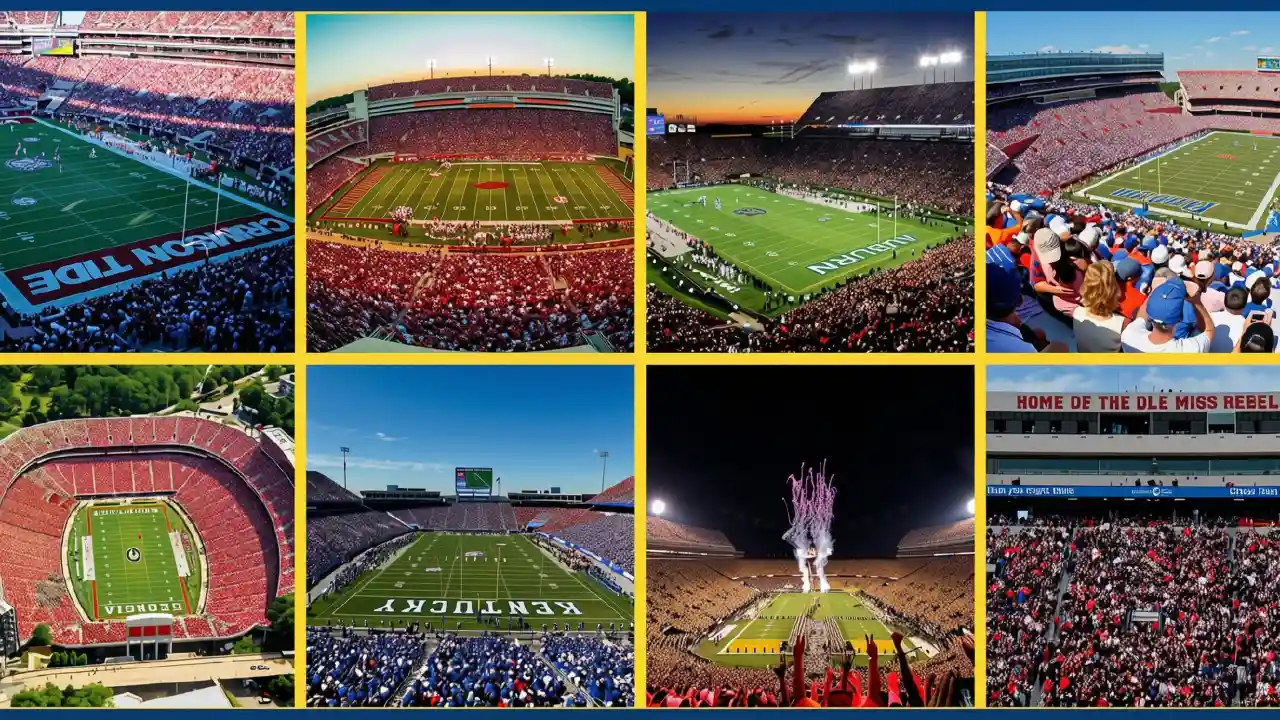
Southeastern Conference football represents the absolute pinnacle of college football passion, pageantry, and architectural scale. Following the historic realignment that added the Texas Longhorns and Oklahoma Sooners, the conference now boasts 16 massive football cathedrals.
Each Saturday in autumn, millions of fans converge on these legendary SEC stadiums, creating elite game-day environments that directly impact the outcome of games. To establish our definitive SEC stadium rankings, we evaluated every active venue based on raw decibel levels, historic traditions, seating capacities exceeding 100,000, and modern fan amenities.
From the terrifying nighttime volume of Death Valley to boutique urban stadiums undergoing multi-million-dollar overhauls, here is how all 16 SEC football venues stack up.
Tiger Stadium — LSU Tigers
- Location: Baton Rouge, Louisiana
- Seating Capacity: 102,321
- Opened: 1924
Why It Ranks No. 1
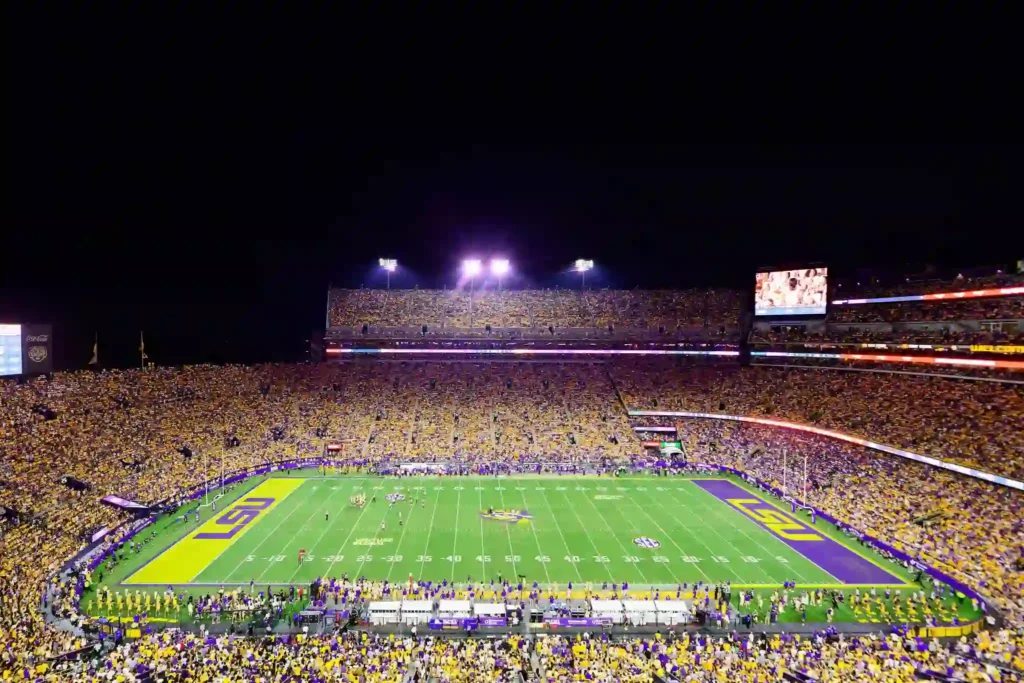
Widely celebrated as “Death Valley,” Tiger Stadium remains the gold standard for atmospheric intensity in NCAA football. The concrete bowl architecture acts as an acoustic trap, reflecting decibel levels that famously registered as an earthquake on a campus seismograph during the 1988 “Earthquake Game” against Auburn.
Game-Day Atmosphere
When night falls over Baton Rouge, the energy shifts into something primeval. Visiting coaches consistently name Tiger Stadium the most hostile environment in the country, especially for high-stakes SEC football matchups under the lights where communication becomes impossible.
Signature Traditions
LSU’s tailgating culture is legendary, centered around Cajun culinary mastery and deep-rooted traditions. Watching the team make the “Victory Hill” march while flanked by the Golden Band from Tigerland sets a terrifying tone for any visiting SEC teams.
Bryant-Denny Stadium — Alabama Crimson Tide
- Location: Tuscaloosa, Alabama
- Seating Capacity: 100,077
- Opened: 1929
Why It Ranks No. 2
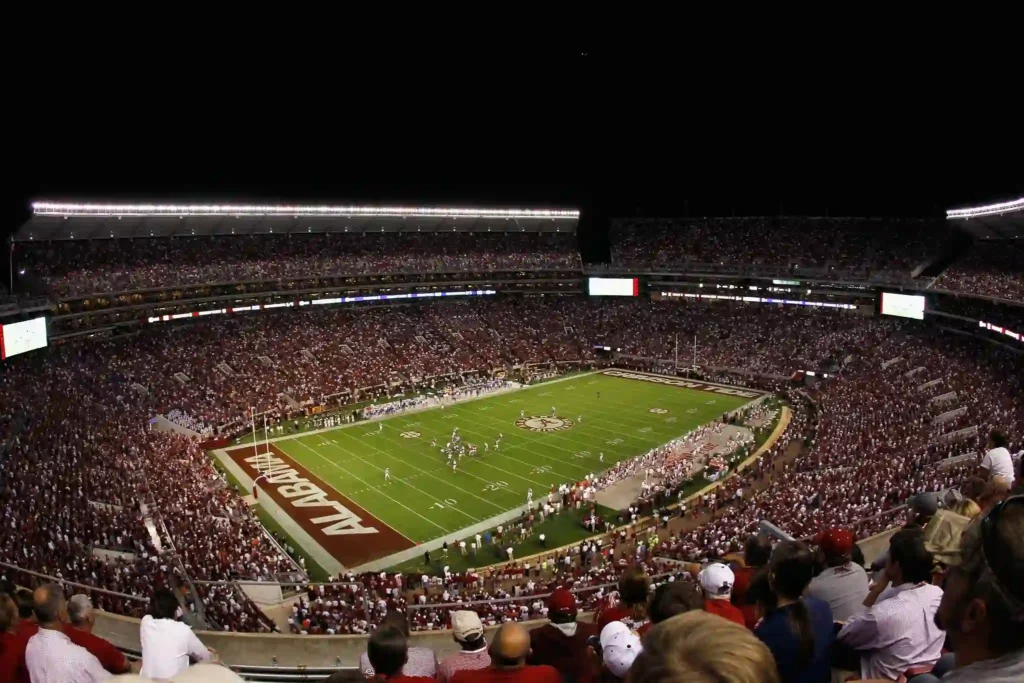
Bryant-Denny Stadium serves as a physical monument to SEC conference history and absolute championship dominance. Named after legendary coach Paul “Bear” Bryant and former university president George H. Denny, this venue combines jaw-dropping scale with a ruthlessly corporate execution of winning.
Game-Day Atmosphere
Inside, the massive LED light system flashes crimson during night games, complementing the deafening roar of 100,000-plus fans. It is an immaculate, pristine, and intimidating bastion of college football royalty that directly shapes the Alabama Football Schedule home advantage.
Signature Traditions
The pre-game Walk of Champions sets a tone of elite expectation, leading past bronze statues of the program’s national championship coaches and iconic SEC champions rosters. In the fourth quarter, the stadium erupts to the traditional playing of “Dixieland Delight.”
Neyland Stadium — Tennessee Volunteers
- Location: Knoxville, Tennessee
- Seating Capacity: 101,915
- Opened: 1921
Why It Ranks No. 3
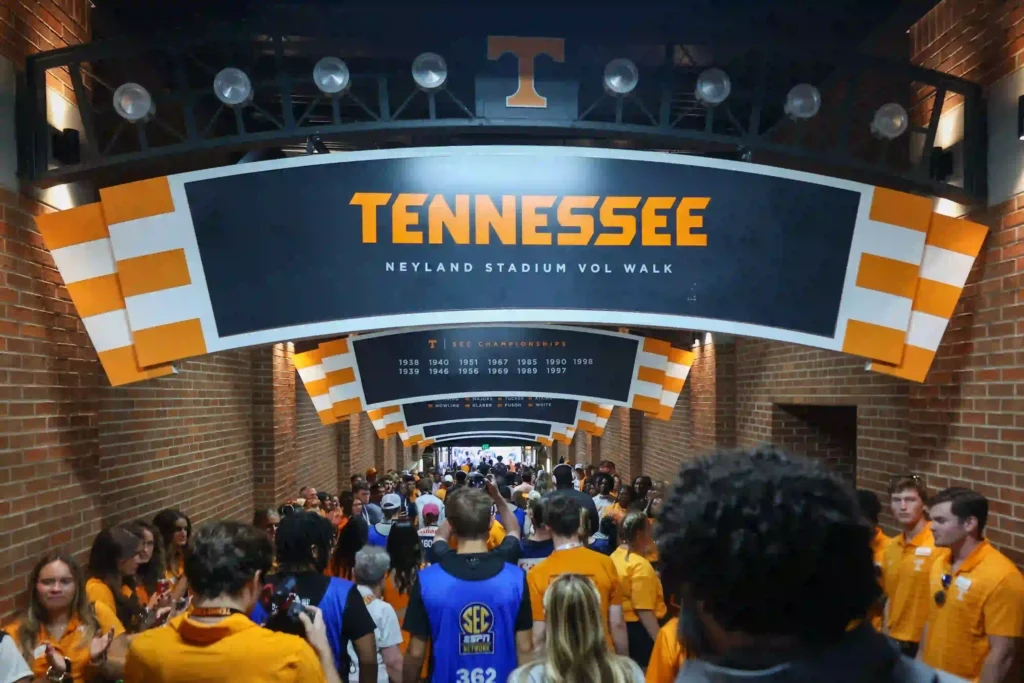
Perched dramatically on the banks of the Tennessee River, Neyland Stadium offers one of the most visually stunning settings in all of sports. Recent multi-million dollar concourse upgrades and premium lounge additions keep Neyland firmly in the elite tier of modern college football.
Game-Day Atmosphere
The double-decked design rises nearly vertically, keeping the massive crowd directly on top of the field. When an opposing team faces a crucial third down, the structural ring reflects crowd noise at a level that easily breaks historic SEC records for volume.
Signature Traditions
The “Vol Volunteer Navy” creates a unique sailgating tradition, where hundreds of boats dock right outside the stadium gates. Inside, the iconic orange-and-white checkerboard end zones frame the field as the Pride of the Southland Band marches out to form the famous “T”.
Kyle Field — Texas A&M Aggies
- Location: College Station, Texas
- Seating Capacity: 102,733
- Opened: 1905
Why It Ranks No. 4
Kyle Field, known affectionately as the “Home of the 12th Man,” is a masterclass in organized passion. With an official capacity pushing near 103,000, it stands structurally as the largest stadium in the Southeastern Conference.
Game-Day Atmosphere
The hallmark of an Aggies home game is the unmatched synchronization of its student body, who stand for the entirety of the game to symbolize their readiness to play. The physical swaying of the deck during the “War Hymn” creates a literal tremor that tests the resolve of any visiting program.
Signature Traditions
Led by the Yell Leaders during the iconic Midnight Yell Practice the night before kickoff, the fan energy is uniform and rhythmic. It represents a level of tradition that is deeply analyzed every summer during SEC Media Days 2026.
Ben Hill Griffin Stadium — Florida Gators
- Location: Gainesville, Florida
- Seating Capacity: 88,548
- Opened: 1930
Why It Ranks No. 5
Better known as “The Swamp,” this stadium is an architectural pressure cooker. Built into a natural sinkhole, the playing field sits below ground level, surrounded by steep, towering concrete stands that lock in heat, humidity, and crowd noise.
Game-Day Atmosphere
The physical environment is oppressive for visiting teams, particularly during early autumn afternoons when temperatures on the turf routinely cross 100°F. The collective swaying of 88,000-plus fans doing the “Gator Chomp” to the ominous jaws theme is an unforgettable visual.
Signature Traditions
The transition into the fourth quarter features the stadium singing Tom Petty’s “I Won’t Back Down,” uniting the entire crowd in a chilling, goosebump-inducing moment of solidarity that honors local Gainesville history.
Jordan-Hare Stadium — Auburn Tigers
- Location: Auburn, Alabama
- Seating Capacity: 87,451
- Opened: 1939
Why It Ranks No. 6
Jordan-Hare Stadium possesses an intangible, mystical quality often referred to as “Auburn Magic.” It is a place where chaotic, historic plays—like the legendary “Kick Six” in the 2013 Iron Bowl—seem to happen naturally, disrupting national title hopes and shifting the SEC standings instantly.
Game-Day Atmosphere
The crowd intensity is hyper-reactive and explosive. When an opposing team faces a crucial third down, the acoustic pressure from the student section rivalries makes pre-snap communication nearly impossible for traveling quarterbacks.
Signature Traditions
The game-day experience begins with the breathtaking Eagle Flight, where a live golden or bald eagle circles the bowl before landing at midfield. Following a victory, fans race to Toomer’s Corner to roll the historic oak trees in white tissue.
Sanford Stadium — Georgia Bulldogs
- Location: Athens, Georgia
- Seating Capacity: 92,746
- Opened: 1929
The Setting Between the Hedges
Sanford Stadium is celebrated as one of the most beautiful yet intimidating settings in the NCAA. Games are famously played “Between the Hedges,” referring to the privet hedges that have lined the natural grass field since its inception in 1929.
Modern Game-Day Adjustments
Despite its picture-perfect aesthetic, the venue transforms into an absolute wall of sound. The introduction of the “Light Up Sanford” tradition, where fans activate their smartphone flashes while the stadium lights drop before the fourth quarter, highlights a team routinely competing for the College Football Playoff.
Darrell K Royal-Texas Memorial Stadium — Texas Longhorns
- Location: Austin, Texas
- Seating Capacity: 100,119
- Opened: 1924
Enclosing a Six-Figure Cathedral
As one of the newest crown jewels in the SEC, “DKR” brings a massive six-figure capacity and an incredibly modern aesthetic to the conference landscape. Located in the heart of Austin, the stadium underwent massive south end zone renovations to completely enclose the bowl, amplifying the acoustics significantly.
Lone Star State Pageantry
The game-day pageantry features “Bevo,” the massive, live Texas Longhorn steer, alongside the booming blast of “Big Bertha,” one of the world’s largest bass drums. High-stakes night games under the glow of the “Hook ’em Horns” hand signs prove DKR can match the intensity of traditional SEC schools.
Gaylord Family Oklahoma Memorial Stadium — Oklahoma Sooners
- Location: Norman, Oklahoma
- Seating Capacity: 86,112
- Opened: 1925
Blue-Blood Infrastructure
The “Palace on the Prairie” represents decades of blue-blood football excellence. Enclosed fully in 2016, the stadium traps noise far better than its previous open-ended iterations, providing a dense, loud backdrop for Sooners football.
Tradition on the Prairie
The entrance of the Sooner Schooner—a classic covered wagon pulled by two white ponies named Boomer and Sooner—is an iconic tradition. The crowd is highly intelligent and deeply invested in every play, reflecting a program that boasts numerous Heisman Trophy winners and legendary historic depth.
Williams-Brice Stadium — South Carolina Gamecocks
- Location: Columbia, South Carolina
- Seating Capacity: 77,559
- Opened: 1934
The Overhanging Structural Sway
Williams-Brice Stadium punches far above its capacity weight class. Famously called “Willy-B,” the venue features a unique structural design with overhanging upper decks that noticeably sway when the crowd gets moving in unison.
The Best Entrance in College Football?
The pre-game entrance is widely considered an elite sequence: the opening notes of “2001: A Space Odyssey” echo through the stadium, sparks fly, and the entire stadium erupts into a rhythmic frenzy. The sheer passion of the fan base ensures that Williams-Brice remains a trap door for highly ranked opponents on the SEC schedule.
Vaught-Hemingway Stadium — Ole Miss Rebels
- Location: Oxford, Mississippi
- Seating Capacity: 64,038
- Opened: 1915
Tailgating in The Grove
While Vaught-Hemingway Stadium is on the smaller side relative to the SEC’s 100,000-seat monsters, the overall game-day environment is bolstered by the greatest pre-game tailgating scene in America: The Grove. This 10-acre oasis filled with oak trees features thousands of fans dining under elaborate tents with chandeliers.
The Intimate Bowled-In Volume
Once inside the stadium, the energy translates into the famous “Hotty Toddy” chant. Recent updates have completely bowled in the stadium, improving the acoustic trap and making it an incredibly loud, intimate venue when the Rebels are competing for top spots in the conference.
Donald W. Reynolds Razorback Stadium — Arkansas Razorbacks
- Location: Fayetteville, Arkansas
- Seating Capacity: 76,000
- Opened: 1938
A Singular State’s Passion
Nestled beautifully within the scenic Ozark Mountains, Donald W. Reynolds Razorback Stadium represents an entire state’s singular athletic passion. Without any major professional sports teams in Arkansas, the energy of the entire populace funnels directly into Fayetteville.
Calling the Hogs
The defining characteristic of a Razorbacks game is the chilling “Calling the Hogs” chant (“Wooo Pig Sooie!”). When synchronized across 76,000 fans, the bass of the chant creates an incredibly eerie, echoing environment that rattles opposing SEC coaches and players alike.
Davis Wade Stadium — Mississippi State Bulldogs
- Location: Starkville, Mississippi
- Seating Capacity: 61,337
- Opened: 1914
The Metallic Wall of Sound
Davis Wade Stadium possesses a unique characteristic that separates it from every other stadium in the country: the cowbell. Thanks to a historic compromise in SEC rules, fans are allowed to ring institutional cowbells at specific times during the game.
Quarterback Nightingales
The stadium is compact, historic, and places the fans right on top of the benches. While it lacks the sheer architectural scale of the top-tier venues, the relentless clanging of thousands of cowbells makes a trip to Starkville an acoustic nightmare for opposing offenses attempting line adjustments.
Faurot Field at Memorial Stadium — Missouri Tigers
- Location: Columbia, Missouri
- Seating Capacity: 62,621
- Opened: 1926
The Historic Rock “M”
Faurot Field is a beautiful, classic venue defined by its historic rock “M” beyond the north end zone, constructed by the university’s freshman class out of leftover stadium rocks in 1927.
Rising Midwestern Volumes
The stadium sits in a natural bowl, offering excellent sightlines and a family-friendly tailgating atmosphere. Under the guidance of recent coaching successes, fan engagement has surged, leading to consecutive sellouts and an increasingly loud home-field advantage against traditional SEC rivalries.
Kroger Field — Kentucky Wildcats
- Location: Lexington, Kentucky
- Seating Capacity: 61,000
- Opened: 1973
Modern Comforts in the Bluegrass
Kroger Field (formerly Commonwealth Stadium) is a thoroughly modern, clean, and highly comfortable venue. Because the University of Kentucky is historically rooted in its elite basketball culture, the football stadium has occasionally flown under the national radar.
Caught Off Guard
Major renovations completed over the past decade transformed the facility, downsizing the capacity slightly to install luxury suites, wider concourses, and better sightlines. When top-ranked SEC teams come to town under the lights, the Bluegrass faithful fill the stadium with a sea of blue that can catch unsuspecting opponents completely off guard.
FirstBank Stadium — Vanderbilt Commodores
- Location: Nashville, Tennessee
- Seating Capacity: 28,934
- Opened: 1922
The Vandy United Overhaul
FirstBank Stadium is comfortably the smallest venue in the Southeastern Conference. Long viewed as a passive stop on the SEC schedule, the facility is currently undergoing a massive, multi-million dollar transformation via the “Vandy United” campaign to completely modernize the end zones, premium seating, and student fan areas.
A Boutique Urban Strategy
What it lacks in raw capacity, it makes up for with its prime location in Nashville, often drawing massive contingent crowds of traveling fans. It serves as an interesting contrast to programs that feed directly into sending talent to the professional ranks, as tracked via our analysis of the NFL Top 25 Under 25. With a re-engineered facility taking shape, Vanderbilt aims to create a tight, loud, and modern boutique stadium experience.
SEC Football Stadiums At-A-Glance
| Rank | Stadium Name | School | Seating Capacity | Signature Tradition / Unique Feature |
| 1 | Tiger Stadium | LSU | 102,321 | Saturday Night Games / Earthquake Sound |
| 2 | Bryant-Denny Stadium | Alabama | 100,077 | “Dixieland Delight” / Walk of Champions |
| 3 | Neyland Stadium | Tennessee | 101,915 | Vol Navy Sailgating / “Rocky Top” |
| 4 | Kyle Field | Texas A&M | 102,733 | The 12th Man Standing / Midnight Yell |
| 5 | Ben Hill Griffin Stadium | Florida | 88,548 | “The Swamp” / Tom Petty Singalong |
| 6 | Jordan-Hare Stadium | Auburn | 87,451 | Pre-game Eagle Flight / Rolling Toomer’s |
| 7 | Sanford Stadium | Georgia | 92,746 | Playing “Between the Hedges” |
| 8 | DKR-Texas Memorial | Texas | 100,119 | Bevo the Longhorn / Austin City Skyline |
| 9 | Oklahoma Memorial | Oklahoma | 86,112 | Sooner Schooner Wagon Entrance |
| 10 | Williams-Brice Stadium | South Carolina | 77,559 | “2001: A Space Odyssey” / Swaying Decks |
| 11 | Vaught-Hemingway | Ole Miss | 64,038 | The Grove Elite Luxury Tailgating |
| 12 | Donald W. Reynolds | Arkansas | 76,000 | “Calling the Hogs” (Woo Pig Sooie) |
| 13 | Davis Wade Stadium | Mississippi State | 61,337 | Synchronized Institutional Cowbells |
| 14 | Faurot Field | Missouri | 62,621 | The Historic Earth and Rock “M” |
| 15 | Kroger Field | Kentucky | 61,000 | Cat Walk / Intimate Bluegrass Setting |
| 16 | FirstBank Stadium | Vanderbilt | 28,934 | Boutique Nashville Urban Experience |
FAQs
Which SEC stadium has the largest capacity?
Kyle Field at Texas A&M holds the largest official seating capacity in the SEC with 102,733 seats, narrowly edging out Tennessee’s Neyland Stadium and LSU’s Tiger Stadium.
Why is LSU’s Tiger Stadium considered the hardest place to play?
Tiger Stadium’s architectural bowl design traps acoustic waves, resulting in documented decibel levels over 130. Combined with the raucous atmosphere of night kickoffs and passionate fans, it creates unparalleled logistical difficulties for visiting offenses.
What are the new stadium additions to the SEC?
Following the historic expansion of the conference, Darrell K Royal-Texas Memorial Stadium (Texas) and Gaylord Family Oklahoma Memorial Stadium (Oklahoma) are now official SEC stadiums.
Which SEC stadium is the oldest?
Kyle Field (Texas A&M) originally opened for play in 1905, making it the oldest structural site, while Davis Wade Stadium (Mississippi State) opened its doors in 1914 as the second-oldest.
Conclusion
Ranking the football cathedrals of the Southeastern Conference is a challenge because every venue brings its own deep-rooted culture and intense atmosphere to autumn Saturdays. With the addition of Texas and Oklahoma, the SEC has solidified its status as home to the most intimidating, loud, and historic stadiums in college football.
Whether it is the deafening night roar of LSU’s Tiger Stadium, the massive scale of Texas A&M’s Kyle Field, or the pristine elegance of tailgating at Ole Miss’s Grove, these 16 stadiums are far more than just steel and concrete. They are cultural monuments where passion, history, and gridiron excellence meet every week. For any true fan of American sports, experiencing a game day inside one of these legendary venues is an essential bucket-list experience.

Clint Lamb is an Alabama football analyst and college football writer with more than a decade of experience covering the
-
Southeastern Conference Official Website:
-
SEC Football Standings — Official conference standings and team records.
-
SEC Football Schedule — Current and upcoming SEC football game dates and times.
-
-
National Collegiate Athletic Association (NCAA):
-
NCAA Football FBS Hub — Official national stats, schedules, and historical records for college football.
-
-
University Athletics Stadium Guidelines:
-
LSU Tiger Stadium Information — Capacity updates and game-day policies for Death Valley.
-
Texas A&M Kyle Field Guide — Structural records and traditions of the 12th Man.
-
Related articles
Auburn Recruiting History: How the Tigers Built a Winner
Alabama Pro Bowl Players: History, Position Analysis, and NFL Impact
Alabama Defensive Legends: Complete History, Stats, and Era Profiles
Alabama’s Bray Hubbard Shuts Down White Helmet Rumor
Alabama Wide Receivers in NFL: Complete Player Guide, Draft History, and Career Stats