Auburn Head Coaches: A Complete History From George Petrie to Alex Golesh
Few programs in college football have a coaching history as long, or as turbulent, as Auburn’s. Since fielding its first team in 1892, Auburn head coaches have combined for national championships, Heisman Trophy winners, NCAA sanctions, sudden resignations, and—in recent years—a revolving door that has tested the patience of one of the sport’s most passionate…


Few programs in college football have a coaching history as long, or as turbulent, as Auburn’s. Since fielding its first team in 1892, Auburn head coaches have combined for national championships, Heisman Trophy winners, NCAA sanctions, sudden resignations, and—in recent years—a revolving door that has tested the patience of one of the sport’s most passionate fan bases.
Understanding Auburn’s coaching lineage means understanding the program itself. The Tigers have won with defensive-minded program builders, with offensive innovators, and with hires that, in hindsight, never fit the job.
As Auburn enters the 2026 season under its 30th head coach, Alex Golesh, this guide walks through the full list of Auburn head coaches, the records that define them, and where the program stands today.
Quick Facts Table
| Category | Details |
|---|---|
| Total Head Coaches | 30 full-time, plus 4 interim head coaches |
| First Head Coach | George Petrie (1892) |
| Current Head Coach | Alex Golesh (hired Nov. 30, 2025) |
| Winningest Coach (Career Wins) | Ralph “Shug” Jordan — 176 wins (1951-1975) |
| Highest Winning Percentage (multi-year) | Terry Bowden — .730 (1993-1998) |
| National Championships Won by a Head Coach | Shug Jordan (1957), Gene Chizik (2010) |
| College Football Hall of Fame Inductees | Mike Donahue, John Heisman, Shug Jordan, Pat Dye |
| Conference | Southeastern Conference (SEC) |
| Stadium | Jordan-Hare Stadium |
| All-Time Program Record | 782-474-43 (through the 2025 season) |
Auburn’s Full List of Head Coaches
Auburn’s coaching lineage stretches back to the earliest days of Southern football. The table below highlights the program’s most significant tenures—coaches who either won championships, coached multiple seasons, or otherwise shaped the direction of the program.
| Tenure | Head Coach | Overall Record | Notable Achievement |
|---|---|---|---|
| 1892 | George Petrie | 2-2 | Organized Auburn’s first football team |
| 1895-1899 | John Heisman | 12-4-2 | Namesake of the Heisman Trophy; College Football Hall of Fame |
| 1904-1922 (not 1907) | Mike Donahue | 99 wins | First national championship claims; multiple SIAA titles |
| 1934-1942 | Jack Meagher | — | Led Auburn’s first bowl appearance (1937 Bacardi Bowl) |
| 1951-1975 | Ralph “Shug” Jordan | 176-83-6 | 1957 AP national championship; stadium named in his honor |
| 1981-1992 | Pat Dye | 99 wins | Four SEC titles (1983, 1987, 1988, 1989); field named in his honor |
| 1993-1998 | Terry Bowden | 47-17-1 | 11-0 in 1993, ineligible for postseason due to NCAA probation |
| 1998 | Bill Oliver (interim) | 2-3 | Finished the season after Bowden’s resignation |
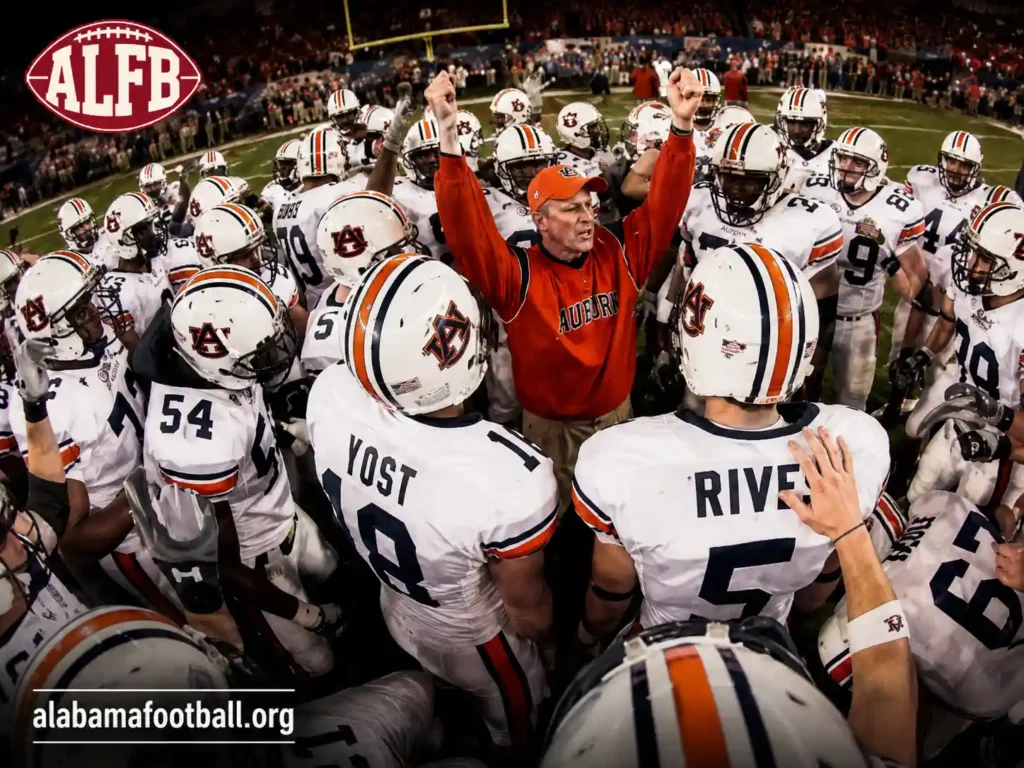
| 1999-2008 | Tommy Tuberville | 85-40 | Won six straight Iron Bowls (2002-2007); 13-0 in 2004 |
| 2009-2012 | Gene Chizik | 33-19 | 2010 BCS national championship; Cam Newton’s Heisman season |
| 2013-2020 | Gus Malzahn | 68-35 | 2013 SEC championship; BCS title game appearance |
| 2020 | Kevin Steele (interim) | Bowl game only | Coached Citrus Bowl loss after Malzahn’s firing |
| 2021-2022 | Bryan Harsin | 9-12 | Worst winning percentage of a non-interim coach since 1950 |
| 2022 | Carnell “Cadillac” Williams (interim) | 2-2 | Stabilized the program after Harsin’s in-season firing |
| 2023-2025 | Hugh Freeze | 15-19 | Fired in-season after a 4-5 start in 2025 |
| 2025 | D.J. Durkin (interim) | 1-2 | Closed out the 2025 season, including the Iron Bowl |
| 2026-present | Alex Golesh | First season | Hired from South Florida on Nov. 30, 2025 |
Historical Context: The Foundational Era
John Heisman (1895-1899)
Long before the trophy bearing his name became college football’s most famous individual award, John Heisman was Auburn’s head coach for five seasons. He compiled a 12-4-2 record and is remembered as one of the sport’s great innovators, credited with popularizing elements of the forward pass era and shaping early Southern football strategy before later making his greatest mark at Georgia Tech.
Mike Donahue (1904-1922)
Mike Donahue is second only to Shug Jordan in career wins and remains second in program history in career winning percentage behind Terry Bowden. An Irish-born Yale graduate, Donahue took over Auburn’s program at age 25 and built the Tigers into a regional powerhouse.
Donahue’s teams won six Southern Intercollegiate Athletic Association championships (1904, 1908, 1910, 1913, 1914, and 1919), and his 1913-1915 squads went 22 games without a loss. His 1914 defense didn’t allow a single point all season, outscoring opponents 193-0. Donahue was part of the inaugural 1951 College Football Hall of Fame class.
The Shug Jordan Era: Auburn’s Winningest Coach
No coach shaped modern Auburn football like Ralph “Shug” Jordan. Jordan coached the Tigers for 25 seasons, from 1951 through 1975, compiling 176 career victories—still the program record. Jordan-Hare Stadium carries his name today, a testament to his standing in program history.
Jordan’s best team came in 1957, when Auburn went 10-0, outscored opponents 207-28, and finished as the Associated Press’s consensus No. 1 team—notably, while the program was on NCAA probation and ineligible to play in a bowl game. He was named SEC Coach of the Year four times during his tenure and was inducted into the College Football Hall of Fame in 1982, two years after his death.
Pat Dye (1981-1992): Rebuilding a Proud Program
Pat Dye took over an Auburn program looking to reestablish itself among the SEC’s elite, and he delivered. Over 12 seasons, Dye won 99 games — tied for second all-time at Auburn — and led the Tigers to four SEC championships, in 1983, 1987, 1988, and 1989.
Dye’s tenure ended amid an NCAA investigation and probation connected to booster payments, but his on-field impact is undisputed. The playing surface at Jordan-Hare Stadium, Pat Dye Field, is named in his honor, and he was later inducted into the College Football Hall of Fame.
The Modern SEC Era: Bowden Through Freeze
Terry Bowden (1993-1998)
Terry Bowden, son of longtime Florida State coach Bobby Bowden, took over immediately after Dye’s departure and produced Auburn’s highest winning percentage of the modern era at .730. His 1993 team went a perfect 11-0, the first undefeated season in program history at that point, but was ineligible for a national championship or bowl game due to NCAA probation inherited from the Dye era.
Bowden resigned in October 1998 after a 1-4 start, and defensive backs coach Bill Oliver finished the season as interim head coach, going 2-3.
Tommy Tuberville (1999-2008)
Tommy Tuberville, later a U.S. senator from Alabama, coached Auburn for a decade and finished 85-40. His signature achievement came in 2004, when Auburn went a perfect 13-0, won the SEC championship, and beat Virginia Tech in the Sugar Bowl—yet was left out of the BCS National Championship Game in favor of Oklahoma and USC.
Tuberville is also remembered for a six-game winning streak against rival Alabama in the Iron Bowl from 2002 through 2007, the longest such streak in the rivalry’s history. He resigned after a 5-7 finish in 2008.
Gene Chizik (2009-2012)
Gene Chizik’s hiring was widely questioned at the time, given his 5-19 record in two seasons at Iowa State. The gamble paid off in dramatic fashion: Chizik’s 2010 Auburn team went a perfect 14-0, won the SEC championship, and defeated Oregon 22-19 in the BCS National Championship Game, with quarterback Cam Newton winning the Heisman Trophy.
Chizik led Auburn to a 33-19 overall record, but the program quickly collapsed afterward—Auburn suffered a 3-9 season and went winless in SEC play in 2012, leading to Chizik’s firing after a 49-0 loss to Alabama.
Gus Malzahn (2013-2020)
Gus Malzahn took over immediately following Chizik’s dismissal and delivered one of the most memorable turnarounds in college football history. His first Auburn team went 12-2, won the SEC championship, and advanced to the BCS National Championship Game, falling to Florida State 34-31 after a season defined by the “Kick Six” win over Alabama and the “Prayer at Jordan-Hare” against Georgia.
Over eight seasons, Malzahn went 68-35 overall (39-27 in SEC play) but never replicated that early success at a championship level. Auburn fired Malzahn following a 6-4 finish in the pandemic-shortened 2020 season, with defensive coordinator Kevin Steele serving as interim head coach for the team’s Citrus Bowl loss.
Bryan Harsin (2021-2022)
Bryan Harsin arrived from Boise State, where he had gone 69-19, on a six-year, $31.5 million contract. His Auburn tenure never gained traction.
Harsin went 6-7 in his first season, then was fired on October 31, 2022, following a 3-5 start, finishing with a 9-12 overall record—the lowest winning percentage for a non-interim Auburn head coach since Earl Brown in the late 1940s. Running backs coach Carnell “Cadillac” Williams served as interim head coach for the final four regular-season games, going 2-2.
Hugh Freeze (2023-2025)
Hugh Freeze was hired largely on the strength of his offensive track record at Ole Miss and Liberty. His Auburn tenure produced strong recruiting classes—including top-10 finishes in 2024 and 2025—but the results on the field never matched.
Auburn fired Freeze on November 2, 2025, after he recorded a 15-19 overall record and a 6-16 mark in SEC play over roughly three seasons, culminating in a home loss to Kentucky. The university owed him $15.8 million in buyout money from the six-year, $49 million contract he signed in 2022.
Defensive coordinator D.J. Durkin finished the season as interim head coach, going 1-2, including a loss to Alabama in the Iron Bowl that left Auburn at 5-7 and outside bowl eligibility.
Alex Golesh: Auburn’s Newest Head Coach
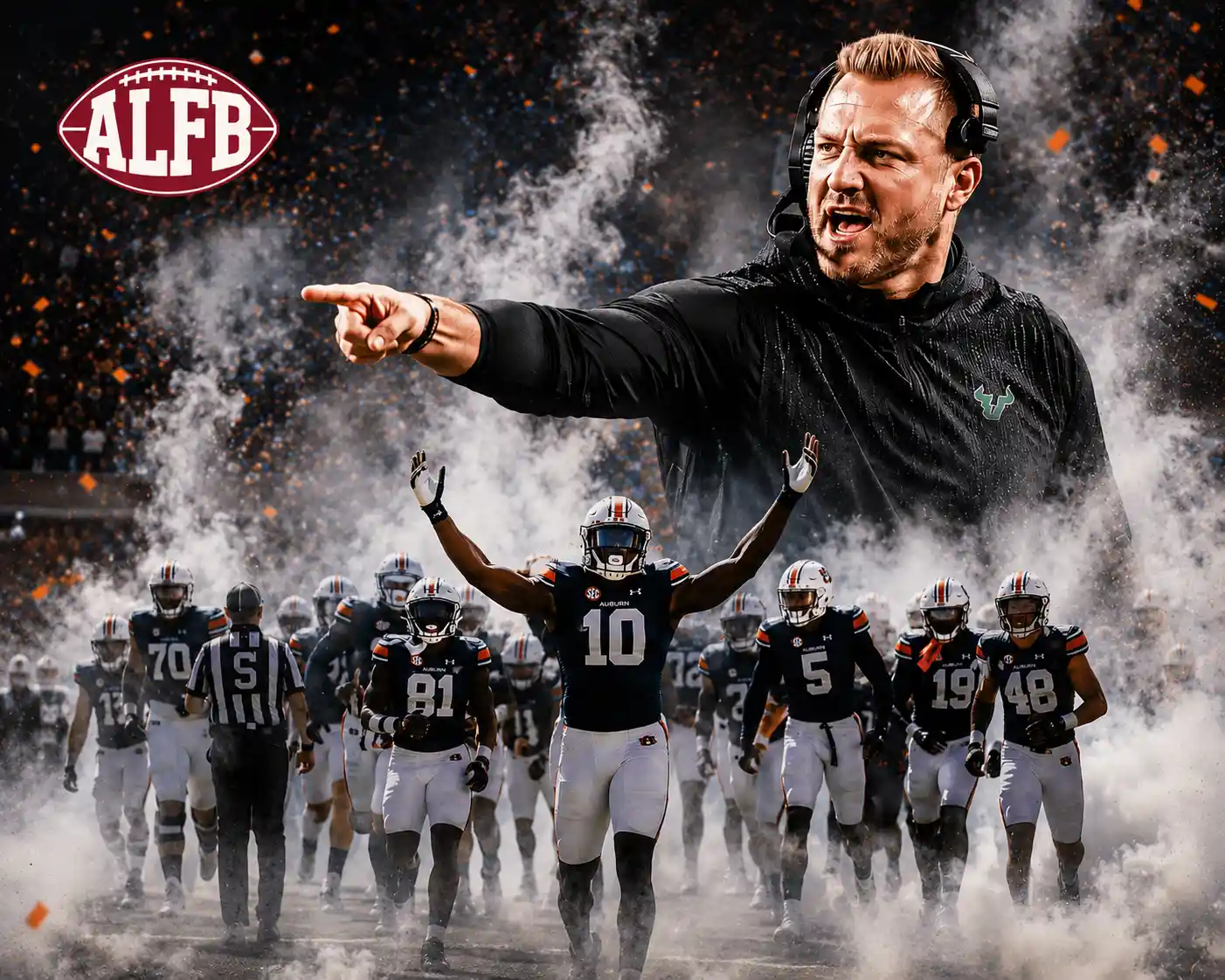
Auburn hired Alex Golesh as its 30th head coach on November 30, 2025, ending a coaching search that lasted roughly four weeks after Freeze’s firing. Golesh arrives after three seasons at South Florida, where he took over a program that had won just four games total over the previous three years and built it into a 23-win team from 2023 through 2025, including a 9-3 finish in his final season.
Golesh is regarded primarily as an offensive innovator. His USF offenses averaged more than 35 points and 450 yards per game, and his 2025 unit ranked No. 2 nationally in total offense and No. 5 in scoring. He previously served as Tennessee’s offensive coordinator in 2022, when the Volunteers fielded the nation’s top-ranked scoring offense at 46.1 points per game with quarterback Hendon Hooker.
Golesh signed a six-year deal at Auburn with an annualized salary starting at $6.75 million. One of his first major decisions was retaining defensive coordinator D.J. Durkin, whose unit ranked fifth in the SEC in yards allowed per play in 2025—a move Golesh described as an easy call, given Auburn’s need for defensive continuity while installing a new offense.
Expert Analysis: What Auburn’s Coaching History Reveals
Strengths of Auburn’s Coaching Approach
Auburn’s history shows a program willing to take chances on coaches without traditional head-coaching pedigrees—Chizik and, in a different way, Golesh both arrived with modest or unproven head-coaching résumés and were hired specifically for their coordinator-level track records. When that bet has worked, as with Chizik in 2010, it has produced championship-level results relatively quickly.
The program has also benefited from long, stable tenures at key points in its history—Donahue, Jordan, and Dye combined for more than 50 years of continuous leadership across a 90-year span, providing generational stability that built Auburn’s championship foundation.
Weaknesses and Recurring Challenges
The flip side of Auburn’s boom-or-bust coaching history is instability. Since Tuberville’s departure in 2008, Auburn has churned through five full-time head coaches and four interim coaches in roughly 17 seasons—a pace far higher than the Jordan-Dye era.
Coaches who arrive with strong reputations, such as Harsin and Freeze, have struggled to replicate their prior success within the SEC’s heightened competitive environment, particularly on the recruiting trail against Georgia and Alabama.
Tactical and Philosophical Trends
Auburn’s most successful coaching stretches have paired an established, often veteran, defensive philosophy with an aggressive, modernized offensive approach—Malzahn’s high-tempo spread offense under Chizik in 2010 is the clearest example. Golesh’s arrival, paired with Durkin’s retained defense, follows a similar blueprint: an offensive-minded head coach layered on top of continuity elsewhere on the roster.
Conclusion
Auburn’s head coaching history is really two stories in one: a program capable of extraordinary highs, built through patient, long-tenured leadership under coaches like Shug Jordan and Pat Dye, and a modern era marked by shorter, higher-turnover tenures that have produced flashes of championship-level football without sustained consistency. Alex Golesh now inherits a program that knows exactly what success looks like — and exactly how quickly it can slip away. How his tenure is remembered will depend on whether he can build the kind of stability that defined Auburn’s greatest eras, rather than repeat the pattern that has defined its last decade and a half.
Frequently Asked Questions
Who has the highest winning percentage among Auburn head coaches?
Among coaches with multiple seasons, Terry Bowden holds Auburn’s highest winning percentage at .730, coaching from 1993 to 1998.
How many national championships have Auburn head coaches won?
Two Auburn head coaches have won championships recognized by the Associated Press: Shug Jordan in 1957 and Gene Chizik in 2010. Auburn’s broader claimed championship total, following a 2025 recognition update, stands at nine across multiple head coaches and eras.
Who is Auburn’s current head coach?
Alex Golesh, hired from South Florida on November 30, 2025, is Auburn’s current head coach entering the 2026 season.
Which Auburn head coaches are in the College Football Hall of Fame?
Mike Donahue, John Heisman, Ralph “Shug” Jordan, and Pat Dye all earned their induction into the College Football Hall of Fame as head coaches.
What is Alex Golesh’s coaching background before Auburn?
Golesh spent three seasons as South Florida’s head coach (2023-2025), going 23-14 overall, and previously served as offensive coordinator at Tennessee and Iowa State, among other stops.
Note: This article reflects the most recent publicly available information as of preseason 2026. Coaching staff assignments and depth charts are subject to change as fall camp progresses.

Nick Serpa is a contributor at Alabama Football, where he covers the latest news, game analysis, recruiting updates, player stories,
- List of Auburn Tigers head football coaches — Wikipedia
- History of Auburn Tigers football — Wikipedia
- Auburn Head Coaches — Auburn Source
- Auburn fires coach Bryan Harsin, who won 9 of 21 games — Alabama Daily News
- Auburn hires South Florida’s Alex Golesh to six-year deal as coach — ESPN
Related articles
Auburn Recruiting History: How the Tigers Built a Winner
Alabama Pro Bowl Players: History, Position Analysis, and NFL Impact
Alabama Defensive Legends: Complete History, Stats, and Era Profiles
Alabama’s Bray Hubbard Shuts Down White Helmet Rumor
Alabama Wide Receivers in NFL: Complete Player Guide, Draft History, and Career Stats