Home / Auburn Tigers / Auburn National Championships: The Complete History Behind College Football’s Newest Nine-Time Champion
Auburn National Championships: The Complete History Behind College Football’s Newest Nine-Time Champion
Auburn national championships have long been a point of pride — and a point of debate — on the Plains. For decades, Auburn fans pointed to two seasons, 1957 and 2010, as the program’s only “true” national titles recognized by the major wire services. That changed in August 2025, when Auburn athletic director John Cohen…


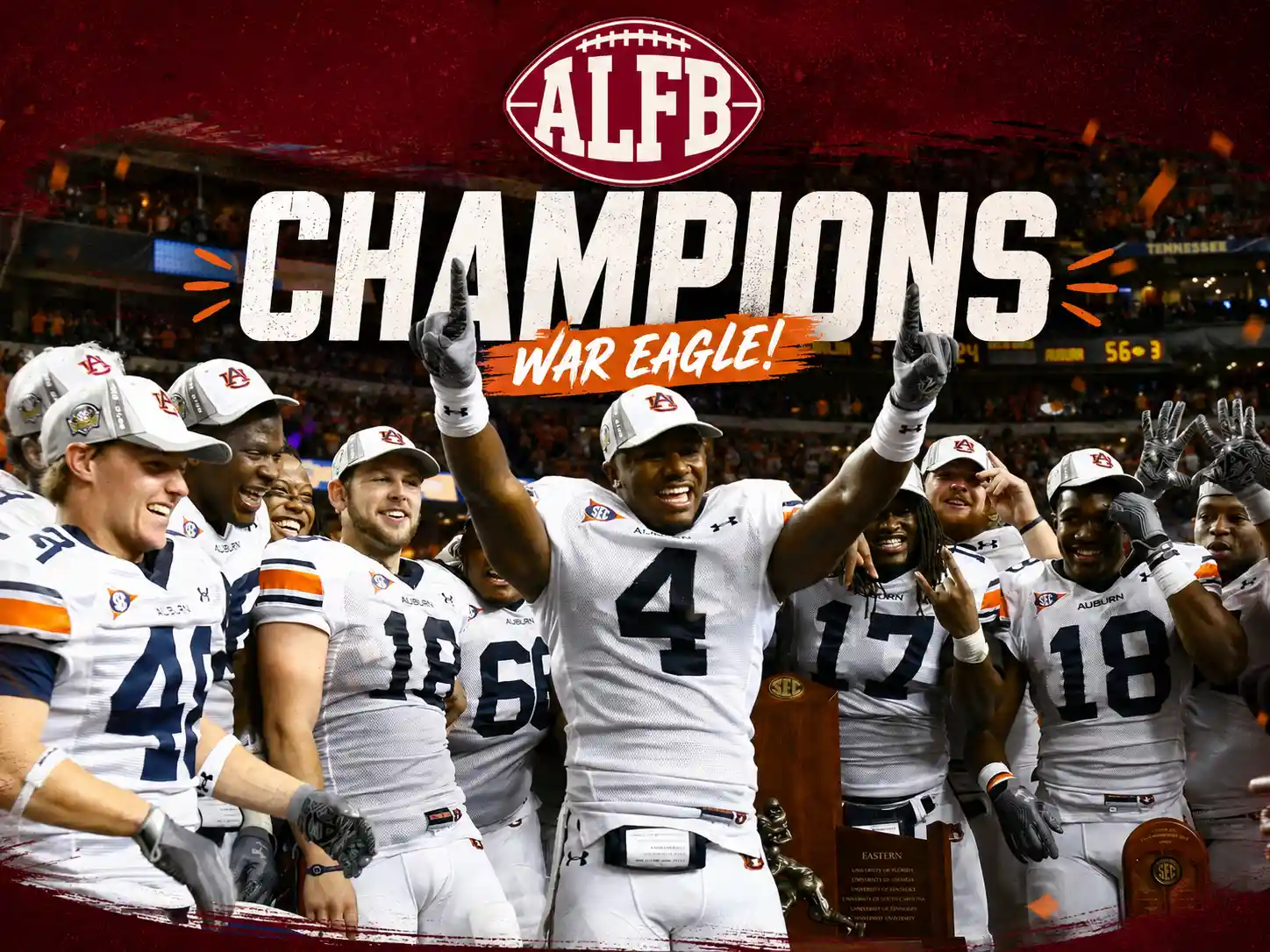
Auburn national championships have long been a point of pride — and a point of debate — on the Plains. For decades, Auburn fans pointed to two seasons, 1957 and 2010, as the program’s only “true” national titles recognized by the major wire services.
That changed in August 2025, when Auburn athletic director John Cohen announced the school would formally recognize seven additional championship seasons, bringing Auburn’s total claimed national championships to nine.
The decision reshaped how Auburn presents its football history, both inside Jordan-Hare Stadium and across its athletic branding. It also reignited a long-running conversation in college football about what actually counts as a national championship in an era before a unified playoff system existed.
This article breaks down every Auburn national championship, the reasoning behind the program’s expanded claims, and how the current Auburn Tigers program under first-year head coach Alex Golesh is positioned entering the 2026 season.
Whether you’re a lifelong Auburn fan or just trying to understand the nine-title claim, here’s what’s accurate, what’s disputed, and what’s ahead for Auburn football.
Quick Facts Table
| Category | Details |
|---|---|
| Claimed National Championships | 9 (1910, 1913, 1914, 1957, 1958, 1983, 1993, 2004, 2010) |
| Consensus/Wire-Service Titles | 2 (1957 AP, 2010 AP/BCS) |
| Conference | Southeastern Conference (SEC) |
| Head Coach (2026) | Alex Golesh (1st season) |
| Stadium | Jordan-Hare Stadium (capacity ~88,000) |
| 2025 Record | 5-7 overall (4-5 under Hugh Freeze, 1-2 under interim D.J. Durkin) |
| SEC Championships (claimed) | 15 |
| Heisman Trophy Winners | 3 (Pat Sullivan, 1971; Bo Jackson, 1985; Cam Newton, 2010) |
| 2026 Season Opener | vs. Baylor (Aflac Kickoff Game, Atlanta) — Sept. 5 |
Auburn’s Nine Claimed National Championships
Auburn’s official position, as of the 2025 announcement, is that the program has won national titles in the following seasons.
| Year | Record | Head Coach | Primary Selector(s) |
|---|---|---|---|
| 1910 | 6-1 | Mike Donahue | Billingsley Report/Maxwell Ratings |
| 1913 | 8-0 | Mike Donahue | Billingsley MOV, NCAA Football Records Book |
| 1914 | 8-0-1 | Mike Donahue | James Howell Power Ratings |
| 1957 | 10-0 | Shug Jordan | Associated Press (AP), consensus |
| 1958 | 9-0-1 | Shug Jordan | Montgomery Full-Season Championship |
| 1983 | 11-1 | Pat Dye | Billingsley, Sagarin, New York Times |
| 1993 | 11-0 | Terry Bowden | National Championship Foundation |
| 2004 | 13-0 | Tommy Tuberville | Multiple computer/statistical selectors |
| 2010 | 14-0 | Gene Chizik | AP, Coaches Poll, BCS (consensus) |
Only the 1957 and 2010 seasons carry recognition from the Associated Press, the sport’s most widely cited historical authority. Auburn claims nine national championships in total: 1910, 1913, 1914, 1957, 1958, 1983, 1993, 2004, and 2010.
The 1957 team went 10-0 and finished as the consensus No. 1 team according to the Associated Press, while the 2010 squad completed a perfect 13-0 season, won the SEC title by defeating South Carolina, and then beat Oregon 22-19 in the BCS National Championship Game, led by Heisman winner Cam Newton.
Why Auburn Added Seven Championships in 2025
The decision to retroactively claim additional titles wasn’t made in a vacuum. According to the announcement, Auburn’s newly recognized national titles align with the standard used in the NCAA’s official football records book, a database that has long listed minor and major selectors alike as legitimate sources for historical national champions.
Athletic director John Cohen framed the move as an overdue correction rather than a marketing stunt. Cohen said Auburn had “chosen a humble approach” for too long by recognizing only AP national championships and that starting in 2025 the school would honor the accomplishments of its past student-athletes, coaches, and teams.
Some of the newly claimed seasons carry more historical weight than others. The 2004 team is often cited by outside media as Auburn’s most defensible “snub.”
The 2004 Tigers went 13-0, won the SEC Championship and the Sugar Bowl, but were left out of the BCS National Championship Game in favor of Oklahoma and USC—a decision that looks worse in hindsight since USC was later stripped of its 2004 title, leaving no officially recognized BCS champion for that season at all.
The 1993 season is arguably the most complicated addition. Auburn finished 11-0 as the only undefeated team in the country that year but was banned from television appearances and postseason play due to NCAA probation, meaning the Tigers never had a chance to play for a title on the field.
The National Championship Foundation later recognized the team as a national co-champion, which is the credential Auburn now leans on.
By contrast, the 1910 and 1914 additions predate modern football media almost entirely and rely on early-era statistical rating systems rather than any poll most fans would recognize today. Auburn’s public messaging acknowledges these were selected by specific historical rating services, not a contemporaneous consensus.
How the Reaction Has Played Out
The move has been polarizing nationally. Coverage from outlets outside Auburn’s own athletic department has generally noted the retroactive nature of the claims.
One national outlet described the decision as “laudable by some and laughable by others,” reflecting a broader skepticism among college football media about programs retroactively adding championship banners for seasons decided by lesser-known rating systems.
It’s worth noting Auburn isn’t alone in this practice—several blue-blood programs, including Alabama and USC, count total national titles using a mix of AP, Coaches’ Poll, and historical selector recognitions.
The debate over “recognized” versus “claimed” titles is one of the more persistent unresolved arguments in college football history, and it predates any single program’s marketing decision.
Historical Context: Auburn’s Two Consensus Titles
The 1957 Season
Auburn’s first widely recognized national championship came under head coach Shug Jordan. The 1957 Tigers finished 10-0 and were the clear consensus No. 1 team according to the Associated Press, capping the year with a 40-0 win over rival Alabama at Legion Field in Birmingham.
The achievement is even more notable given Auburn played the entire season under NCAA probation and was ineligible for a bowl game—the Tigers won the AP title without ever taking the field in the postseason.
The 2010 Season
The 2010 championship remains the gold standard for modern Auburn fans, both for its perfection and its star power.
Auburn completed a 13-0 regular season, defeating South Carolina 56-17 in the SEC Championship Game — a record for points scored and margin of victory in that game at the time — before beating Oregon 22-19 in the BCS National Championship Game on January 10, 2011, in Glendale, Arizona.
Quarterback Cam Newton won the Heisman Trophy that season and quarterbacked what many still consider the most talented offense in program history.
The Near-Miss: 2013
While not a claimed championship, the 2013 season is central to Auburn lore. Coming off a 3-9 season in 2012, first-year coach Gus Malzahn led Auburn to a 12-2 record, an SEC title, and a berth in the BCS National Championship Game against Florida State, which the Tigers lost 34-31.
The “Kick Six” win over Alabama and the “Prayer at Jordan-Hare” against Georgia that season remain among the most replayed moments in college football history, even though the season ended one win short of a title.
Auburn Football Entering 2026: A Program in Transition
Auburn’s on-field results have not matched its championship branding in recent seasons, which is part of why the 2025 title announcement drew mixed reactions. The program is now beginning a new era under a fourth head coach in seven seasons.
The End of the Hugh Freeze Era
Hugh Freeze was fired on November 2, 2025, after a 15-19 overall record and a 6-16 mark in SEC games across three seasons, a stretch capped by a 10-3 home loss to Kentucky. Freeze was owed $15.8 million in buyout money as part of a six-year, $49 million contract signed in 2022.
Despite landing top-10 recruiting classes in 2024 and 2025 and adding notable transfers such as quarterback Jackson Arnold, Freeze’s Auburn teams never posted a winning season, and the offense consistently underperformed relative to its recruiting rankings.
Defensive coordinator D.J. Durkin served as interim head coach for the final three games of 2025, going 1-2, including a narrow 27-20 loss to Alabama in the Iron Bowl that ended Auburn’s season at 5-7 and outside bowl eligibility.
Alex Golesh Takes Over
Auburn named Alex Golesh, who spent three seasons rebuilding the South Florida program from 2023 to ’25, as the 33rd head coach in program history.
Golesh’s USF teams recorded 23 wins over three seasons, including a 9-3 mark in 2025, after the Bulls had won just four games total over the previous three seasons. Golesh signed a six-year deal with Auburn, and his contract carries an annualized salary starting at $6.75 million.
Golesh is known primarily as an offensive-minded coach. His USF offenses averaged more than 35 points and 450 yards per game during his tenure, and the 2025 unit ranked No. 2 nationally in total offense and No. 5 in scoring.
Earlier in his career, Golesh served as Tennessee’s offensive coordinator in 2022, when the Volunteers fielded the nation’s top-ranked offense at 46.1 points per game, working with quarterback Hendon Hooker.
One of Golesh’s first notable decisions was retaining defensive coordinator D.J. Durkin. Auburn ranked fifth in the SEC in yards allowed per play in 2025, at 4.95 yards per snap, and Golesh called the decision to keep Durkin an “easy call.” Durkin’s continuity gives Auburn a proven defensive infrastructure while Golesh installs a new offensive system.
Roster Overhaul: Transfer Portal and Quarterback Room
Auburn’s roster changed dramatically during the 2025-26 offseason. Golesh’s first offseason at Auburn brought 39 transfer portal additions, including quarterback Byrum Brown, who followed Golesh from USF.
Brown is currently projected as the presumptive starter entering fall camp, given his familiarity with Golesh’s system, though as with any offseason quarterback competition, official depth charts are not finalized until closer to the season.
Auburn’s 39-player transfer class finished ranked No. 9 nationally by 247Sports and No. 4 in the SEC, behind LSU, Ole Miss, and Texas.
According to the latest available rankings, Brown himself ranks as the No. 52 overall transfer portal player and the No. 9 quarterback in the class. The Tigers also added depth at running back, offensive line, and defensive back, positions that had been thin under the previous coaching staff.
On the high school recruiting side, Auburn’s 2026 class experienced typical coaching-change turbulence. Auburn signed 15 new high school and junior college prospects on National Signing Day, with the class ranked No. 34 nationally by 247Sports at the time—down from top-10 classes in the two prior cycles, an expected outcome given the compressed recruiting window following a coaching change in late November.
2026 Season Outlook
According to the latest available schedule, Auburn opens the 2026 season away from Jordan-Hare Stadium. The Tigers open on September 5 against Baylor in the Aflac Kickoff Game at Mercedes-Benz Stadium in Atlanta, marking Golesh’s competitive debut as Auburn’s head coach.
Auburn will play six home games at Jordan-Hare Stadium in 2026: Southern Miss (Sept. 12), Florida (Sept. 19), Vanderbilt (Sept. 26), LSU (Oct. 24), Arkansas (Nov. 7), and Samford (Nov. 21). The Florida matchup carries extra weight for fans, as it marks the Gators’ first visit to Auburn since 2011.
Road trips include SEC games at Tennessee (Oct. 3), Georgia (Oct. 17), Ole Miss (Oct. 31), Mississippi State (Nov. 14), and the regular-season finale at Alabama (Nov. 28) in the annual Iron Bowl.
Schedule at a Glance
| Date | Opponent | Location |
|---|---|---|
| Sept. 5 | Baylor | Atlanta (neutral) |
| Sept. 12 | Southern Miss | Jordan-Hare Stadium |
| Sept. 19 | Florida | Jordan-Hare Stadium |
| Sept. 26 | Vanderbilt | Jordan-Hare Stadium |
| Oct. 3 | at Tennessee | Knoxville |
| Oct. 17 | at Georgia | Athens |
| Oct. 24 | LSU | Jordan-Hare Stadium |
| Oct. 31 | at Ole Miss | Oxford |
| Nov. 7 | Arkansas | Jordan-Hare Stadium |
| Nov. 14 | at Mississippi State | Starkville |
| Nov. 21 | Samford | Jordan-Hare Stadium |
| Nov. 28 | at Alabama | Tuscaloosa |
As of the most recent update, Auburn’s 2026 slate is notably tougher than in past seasons, with the SEC’s expansion to a nine-game conference schedule beginning this year. Entering preseason camp, the early expectation among analysts is that Auburn’s floor and ceiling both hinge heavily on quarterback play and offensive line continuity — the same issues that plagued the Freeze era.
Expert Analysis
Strengths
Auburn’s most tangible strength entering 2026 is defensive continuity. Durkin’s unit was the one bright spot during a difficult 2025 campaign, and retaining him gives Golesh a functioning foundation to build around rather than needing to rebuild both sides of the ball simultaneously.
The addition of Byrum Brown also gives Auburn a quarterback who already understands Golesh’s system, which historically has produced high-volume passing and rushing production. If Brown’s chemistry with Golesh translates from USF, Auburn’s offense could look markedly different than it did under Freeze.
Weaknesses
Turnover is the clearest risk. Adding 39 transfer players and an entirely new coaching staff in one offseason creates real uncertainty about locker room chemistry and scheme installation, particularly on the offensive line, where continuity typically matters most.
Auburn’s 2026 recruiting class, while respectable given the circumstances, was a step down from the top-10 classes Auburn signed in 2024 and 2025. Program building under Golesh will likely depend more on transfer portal management than high school recruiting in year one.
Tactical Outlook
Golesh’s system emphasizes tempo and explosive passing concepts, a departure from the more conservative approach Auburn has run in recent seasons. The early expectation is that Auburn’s offense will lean heavily on quick game passing and zone-read concepts to create explosive plays, mirroring what USF ran in 2025.
On defense, Durkin is expected to continue an aggressive, pressure-based scheme that generated strong rushing defense numbers in 2025.
Conclusion
Auburn’s national championship count now stands at nine, a total built on two consensus championships widely recognized across the sport and seven additional seasons recognized through a mix of historical statistical selectors and organizations.
The 2025 decision to formally claim all nine has been debated nationally, but it reflects a broader, long-standing ambiguity in how college football determined champions before the four-team and expanded playoff eras existed.
On the field, Auburn’s focus has shifted from its championship past to its immediate present. With Alex Golesh now leading the program, a retooled roster built through one of the nation’s most productive transfer portal classes, and a defense anchored by a retained coordinator in D.J. Durkin, Auburn enters 2026 attempting to close the gap between its historical branding and its recent on-field results.
Whether the Tigers can return to championship-caliber football will depend far less on 1910 or 1958 than on how quickly Golesh’s new system takes root in the SEC’s toughest conference schedule to date.
Frequently Asked Questions
How many national championships does Auburn claim?
Auburn currently claims nine national championships: 1910, 1913, 1914, 1957, 1958, 1983, 1993, 2004, and 2010.
How many of Auburn’s national championships are recognized by the Associated Press?
Two—the 1957 and 2010 seasons—are recognized by the AP, the sport’s most widely cited major wire-service poll.
Why did Auburn add seven national championships in 2025?
Auburn’s athletic department said the change aligned its public recognition with championships already listed in the NCAA’s official football records book, covering seasons recognized by various historical statistical selectors.
Did Auburn win a national championship in 2013?
No. Auburn finished the 2013 season 12-2 and lost the BCS National Championship Game to Florida State, 34-31. That season is not among Auburn’s claimed titles.
Who is Auburn’s starting quarterback heading into 2026?
Byrum Brown, who followed Golesh from South Florida via the transfer portal, is currently projected as Auburn’s top quarterback option entering the season, according to the latest transfer portal rankings.
Is Auburn’s defense expected to be a strength in 2026?
Yes, according to preseason analysis. Auburn’s defense, coordinated by D.J. Durkin, ranked among the SEC’s better units statistically in 2025, and Durkin was retained specifically to provide continuity on that side of the ball.
Note: This article reflects the most recent publicly available information as of preseason 2026. Depth chart, quarterback competition outcomes, and game times/TV designations are subject to change as fall camp progresses.

Nick Serpa is a contributor at Alabama Football, where he covers the latest news, game analysis, recruiting updates, player stories,
-
- Auburn Tigers football — Wikipedia
-
- Traditions – National Championships — Auburn Tigers Official Athletics
-
- Auburn Football announces 2026 Schedule — Auburn Tigers Official Athletics
Related articles
Auburn Recruiting History: How the Tigers Built a Winner
Alabama Pro Bowl Players: History, Position Analysis, and NFL Impact
Alabama Defensive Legends: Complete History, Stats, and Era Profiles
Alabama’s Bray Hubbard Shuts Down White Helmet Rumor
Alabama Wide Receivers in NFL: Complete Player Guide, Draft History, and Career Stats